
 Rice
 Wheat & Cereals
 Maize, Beans & Seeds
 Plastics & Industrial Materials
 Industrial Motors
 Environmental
 Social
 Governance
 About SATAKE Group
 Top Message
 Global Network


Features
Adoption of Piezo Valves for Higher Foreign Matter Removal Accuracy
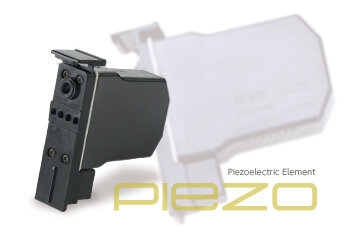
The ejector valve is a critical device that controls the opening and closing of the air-jet valve when removing foreign matter. To minimize the accidental removal of good grains and to improve sorting accuracy, the valve must open and close with agility, as a piezo valve does. Compared with conventional solenoid valves, which open and close using an electromagnet, piezo valves—which harness the piezoelectric effect—enable more precise foreign matter removal.
Improved Responsiveness
The newly developed piezo valve achieves dramatically faster valve opening and closing than conventional solenoid valves, which open and close using an electromagnet.
Reduced Running Costs
Owing to the characteristics of the piezoelectric element, both power consumption and air consumption are reduced, achieving lower running costs.
Fully LED Light Sources
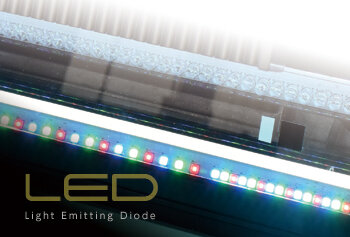
The light sources that illuminate the material flowing down are equipped with RGB LEDs for visible light and LEDs for near-infrared, while white LEDs are used for the background that serves as the reference for detecting the material. A large volume of information obtained from the four-color LEDs and the full-color camera is accurately identified using SATAKE's proprietary image processing technology (Patent No. 6152845).
- Significantly reduced warm-up operation at startup
- Extended service life of the light sources
- Equipped with a standby mode to reduce power consumption
During standby, the light output is lowered, so no power is wasted.
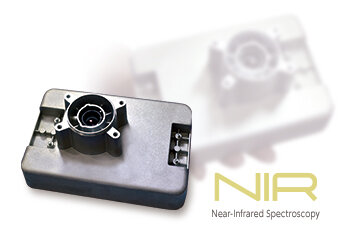
Two Wavelengths, Two Near-Infrared Cameras
In the visible light range of the full-color camera, transparent foreign matter or foreign matter of the same color cannot be detected. Near-infrared (NIR) light is therefore used to sort foreign matter based on its spectral characteristics (transmission, reflection, etc.). The "SLASH" is equipped with two near-infrared cameras of different wavelengths, improving the sorting accuracy for foreign matter such as silica gel and transparent resin.
Improved Chalky Grain Sorting Performance
By using bright LEDs instead of CCFLs (cold-cathode fluorescent lamps) as the light source, the sorting performance for chalky grains (milky-white rice) has improved without reducing the sorting capability for discolored grains.
Layout Options to Suit Your Needs
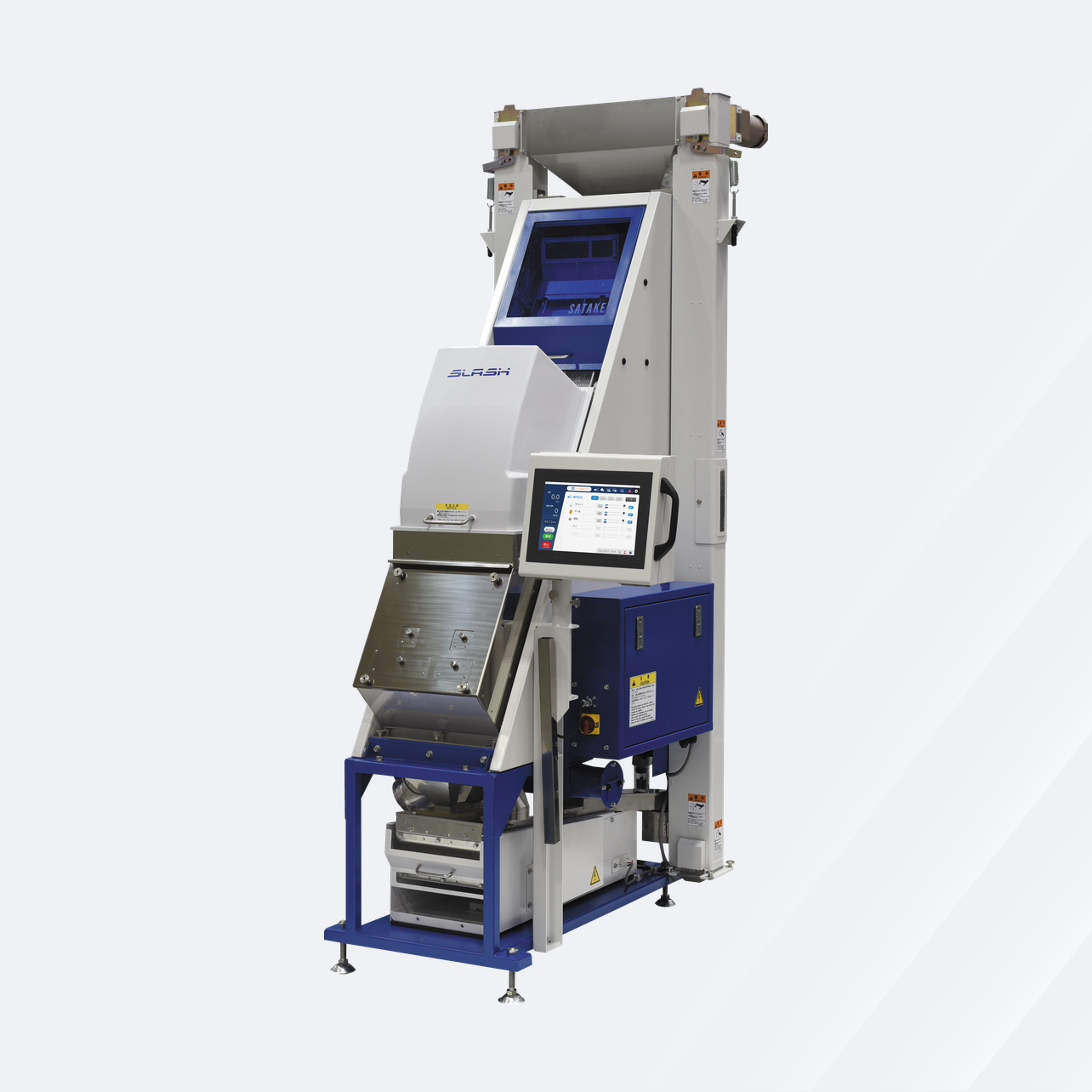
The good-product outlet can be positioned on either the left or right.
How Sorting Works
Rice flowing down the chute is inspected by two types of cameras. The full-color camera detects discolored grains, while the near-infrared (NIR) camera detects inorganic materials such as glass and stones. These defective grains and foreign matter are then sorted out and removed by an air jet from the ejector (piezo valve).
Specifications
| Model | VQS-01AM |
|---|---|
| Processing capacity * | Brown rice: 0.4~2.6 t/h, Milled rice: 0.4~2.9 t/h |
| Main applications | ① Non-glutinous rice (brown/milled), ② Glutinous rice (brown/milled), ③ Others (wheat, barley, dried paddy, minor cereals, pellets, etc.) |
| Required power | Single-phase 200V 2.0kW |
| Air consumption * | 240 Nℓ /min |
| Required dust collection | 4 ㎥ /min |
| Cameras | Full-color ×2, near-infrared (NIR) ×2 |
| Light source | LED |
| Conveying equipment | Feeders ×2, vibrating feeder ×1, bucket elevator for primary defective grains ×1, bucket elevator for secondary good grains ×1 |
| Machine weight | 365 kg |
| Options | U-groove chute for primary sorting (processing capacity: 0–1.0 t/h) |
※ Processing capacity and air consumption vary depending on the proportion of defective grains contained in the material.
Dimensions
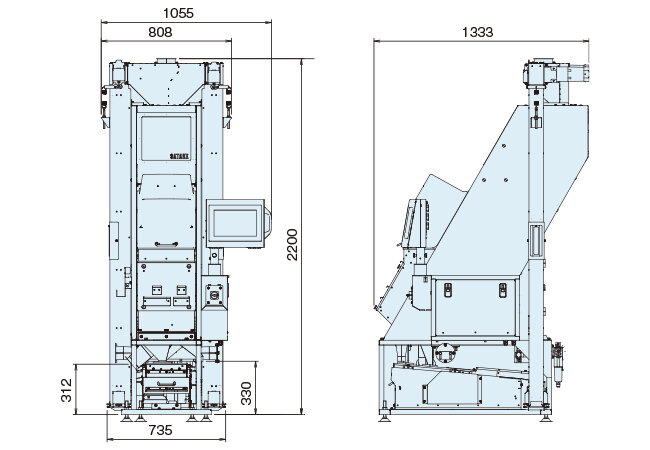
Machine Dimensions (unit: mm)